Introduction
Artificial intelligence is no longer a distant future trend; it is the fundamental force reshaping how organizations hire, how teams perform, and how leaders compete. From healthcare and finance to manufacturing and marketing, AI is now woven into the fabric of everyday work.
For professionals, this shift brings both uncertainty and opportunity. While valid concerns regarding automated displacement persist, a new reality is emerging: forward-thinking organizations are aggressively seeking talent capable of harmonizing technical literacy with uniquely human strengths—critical judgment, creative problem-solving, and visionary leadership.
The reality is simple: AI is changing work, but it is not replacing the need for people. The professionals who will thrive in the coming decade will be those who master the ability to adapt, continuously learn, and leverage technology to amplify the value they bring to their employers, clients, and communities.
This guide was created to help you do exactly that. Whether you are navigating a job transition, building a business, or leading organizational change, you will find here the practical insights, proven frameworks, and actionable strategies you need to confidently navigate your career in the AI economy.
Executive Summary
The AI economy is driving the most profound workplace transformation since the dawn of the internet. As organizations reengineer workflows and deploy intelligent tools, job roles are evolving and new opportunities are emerging. Succeeding in this landscape requires more than just technical awareness; it demands a strategic shift in how you view your career.
This guide serves as your roadmap for navigating every stage of this evolution.
You will learn how to:
- Decode the AI economy and its personal impact,
- Identify high-growth opportunities across transforming industries,
- Master the skills that yield the highest professional ROI,
- Forge long-term career resilience,
- Apply the AAA Framework—Align, Adapt, Achieve—to your journey,
- Optimize your job search and leadership presence for an AI-driven market.
Move beyond uncertainty and take control of your professional future. By understanding these shifts today, you position yourself to lead and thrive in the workplace of tomorrow.
Part 1
The AI Economy Explained
Executive Summary
Artificial intelligence is transforming how value is created across every industry. Compared to previous technological revolutions that primarily automated physical labor or digitized information, AI assists with cognitive work—analyzing data, generating content, supporting decisions, and accelerating innovation. Understanding this shift is the first step toward making informed career decisions.
What Is the AI Economy?
The AI economy is an economic environment where artificial intelligence is embedded into products, services, business processes, and decision-making. AI is no longer confined to technology companies. It is influencing healthcare, finance, manufacturing, education, retail, government, and virtually every professional field.
For workers, this means career success increasingly depends on understanding how to collaborate with intelligent technologies while strengthening uniquely human capabilities.
Why This Transformation Is Different
Previous waves of technology changed where and how work was performed. AI changes how knowledge itself is created and applied. It can summarize research, generate first drafts, analyze trends, and assist with routine decision-making.
This changes expectations. Employers increasingly value professionals who can interpret AI-generated information, communicate effectively, solve complex problems, and exercise sound judgment.
AI ERA Insight
Technology changes tools. Human capability creates value.
Organizations invest in AI to increase productivity. They invest in people to create innovation, build relationships, and lead through change. Professionals who understand both sides of that equation will be well positioned for the future.
Career Reflection
Consider your current role.
- Which tasks are repetitive?
- Which requires judgment, empathy, or creativity?
- Where could AI help you become more effective rather than replace your contribution?
Key Takeaways
- The AI economy is reshaping every industry.
- AI changes tasks more often than it replaces occupations.
- Human judgment remains essential.
- Adaptability is becoming a defining career advantage.
Part 2
How Artificial Intelligence Is Changing Work
Executive Summary
AI is transforming work in four primary ways: automation, augmentation, workflow transformation, and innovation. Understanding these stages helps professionals anticipate change instead of reacting to it.
The Four Stages of Transformation
1. Automation
Routine, repetitive tasks become automated, reducing administrative effort and increasing efficiency.
Examples include scheduling, transcription, data entry, reporting, and basic customer support.
2. Augmentation
AI becomes a collaborator, helping professionals draft documents, analyze data, summarize research, and generate ideas.
Human expertise remains responsible for context, judgment, ethics, and decision-making.
3. Workflow Transformation
Organizations redesign entire business processes to integrate AI into daily operations.
Teams shift from producing information to interpreting it, making decisions, and creating value.
4. Innovation
AI enables entirely new products, services, and careers that previously did not exist.
Human + AI
The future is not “Human versus AI.”
It is “Human with AI.”
Professionals who understand how to combine their expertise with intelligent tools will often outperform those relying solely on traditional methods.
AI ERA Insight
AI increases speed. People determine direction.
Career Reflection
Ask yourself:
- Which responsibilities in my role are becoming easier because of AI?
- Which responsibilities will always require trust, communication, or leadership?
Action Checklist
- Identify one AI tool relevant to your profession.
- Experiment with it this week.
- Reflect on how it could improve—not replace—your work.
Key Takeaways
- AI is changing work rather than eliminating it.
- Human-centered skills are becoming more valuable.
- Continuous learning is now part of career success.
Industries Undergoing Transformation
Part 3
Executive Summary
Every industry is experiencing AI differently. Understanding these differences allows professionals to make informed career decisions and identify emerging opportunities before they become mainstream.
Industry Snapshot
Industry |
AI Impact |
Emerging Opportunities |
| Healthcare | Clinical decision support, diagnostics | Digital Health, Clinical AI |
| Finance | Risk analysis, fraud detection | AI Compliance, Wealth Advisory |
| Marketing | Personalization, content generation | AI Strategy, Customer Experience |
| Human Resources | Recruiting, workforce analytics | Workforce Planning, Employee Experience |
| Education | Personalized learning | Learning Design, EdTech |
| Manufacturing | Predictive maintenance, robotics | Smart Manufacturing, Automation |
| Professional Services | Research, drafting, analytics | AI Advisory, Digital Transformation |
Healthcare
AI is helping clinicians analyze medical images, identify disease patterns, and reduce administrative burdens. Rather than replacing healthcare professionals, it enables them to spend more time on patient care and clinical judgment.
What This Means for You: Focus on technology fluency while strengthening communication, empathy, and interdisciplinary collaboration.
Financial Services
Banks and investment firms use AI for fraud detection, forecasting, and risk management. Professionals increasingly add value through strategic advice, client relationships, and ethical oversight.
What This Means for You: Develop analytical thinking and advisory skills alongside AI literacy.
Marketing
AI can generate content, analyze customer behavior, and optimize campaigns, but creativity, storytelling, and brand strategy remain distinctly human responsibilities.
What This Means for You: Position yourself as a strategist who uses AI to amplify—not replace—creative thinking.
Human Resources
Recruiters use AI to screen candidates and analyze workforce trends. HR professionals are spending more time on coaching, organizational development, and culture.
What This Means for You: Strengthen skills in leadership development, change management, and employee experience.
Education
Educators are using AI to personalize learning and automate administrative tasks. Teachers increasingly act as facilitators, mentors, and coaches.
What This Means for You: Embrace technology while focusing on mentoring, critical thinking, and student engagement.
Manufacturing
AI improves quality control, supply chain management, and predictive maintenance, creating demand for professionals who understand both operations and intelligent systems.
What This Means for You: Build expertise in automation, data interpretation, and continuous improvement.
Professional Services
Consultants, lawyers, accountants, and project managers are integrating AI into research, drafting, and analysis. Clients continue to value trusted advisors who provide judgment and strategic guidance.
What This Means for You: Focus on solving complex business problems and communicating recommendations clearly.
Career Signals to Watch
Monitor your industry for:
- New AI-related job titles
- AI tools appearing in job postings
- Increased demand for data literacy
- Greater emphasis on change management
- Growing need for ethical AI governance
These signals often indicate where future opportunities are emerging.
AI ERA Insight
The question isn’t whether your industry will change. The question is how quickly you’ll recognize—and prepare for—the opportunities that change creates.
Career Reflection
Review five current job postings in your profession.
What new skills, tools, or responsibilities appear repeatedly?
Those patterns often reveal where your profession is heading.
Action Checklist
- Identify three AI trends affecting your industry.
- Research one emerging role that interests you.
- Choose one skill to begin developing over the next 90 days.
Key Takeaways
- Every industry is being transformed by AI, but at different speeds.
- Most professions are evolving rather than disappearing.
- Understanding industry trends helps you make proactive career decisions.
- Combining industry expertise with AI fluency creates long-term value.
Part 4
The Skills That Will Define Career Success
Executive Summary
The future of work is not defined by choosing between human skills and artificial intelligence—it is defined by learning how to combine them effectively.
As AI becomes increasingly capable of performing routine and analytical tasks, employers are placing greater value on professionals who demonstrate adaptability, critical thinking, emotional intelligence, communication, and leadership. Technical proficiency remains important, but it is no longer sufficient on its own.
The professionals who thrive will be lifelong learners who embrace technology while strengthening the uniquely human capabilities that AI cannot easily replicate.
Quick Answer
What skills will matter most in the AI Economy?
Career success will increasingly depend on developing five categories of skills:
- AI Literacy
- Human-Centered Skills
- Business & Strategic Thinking
- Digital Collaboration
- Learning Agility
Together, these create a balanced professional capable of adapting to continuous change.
The Five Skill Domains
1. AI Literacy
AI literacy is not about becoming a programmer.
It is about understanding:
-
- What AI can do,
- What it cannot do,
- When to use it,
- When not to rely on it,
- How to verify AI-generated information.
Professionals who understand AI become more productive without becoming dependent on technology.
Examples:
-
- Writing better prompts
- Evaluating AI output
- Understanding AI bias
- Using AI responsibly
2. Human-Centered Skills
As technology becomes more capable, human capabilities become more valuable.
These include:
-
- Communication
- Empathy
- Leadership
- Coaching
- Negotiation
- Collaboration
- Creativity
- Critical Thinking
- Ethical Judgment
Organizations consistently identify these as differentiators among high-performing professionals.
3. Business and Strategic Thinking
Knowing how to do something is important.
Understanding why it matters to the business is what accelerates careers.
Professionals who think strategically:
-
- solve problems,
- improve processes,
- identify opportunities,
- make informed decisions,
- connect their work to organizational goals.
4. Digital Collaboration
The modern workplace is increasingly distributed and technology-enabled.
Professionals should be comfortable collaborating through:
-
- AI copilots
- Collaboration platforms
- Project management tools
- Knowledge management systems
- Digital workflows
Technology should remove friction—not create it.
5. Learning Agility
Perhaps the most valuable capability is the willingness and ability to learn continuously.
Learning agility means:
-
- staying curious,
- experimenting,
- adapting quickly,
- seeking feedback,
- applying new knowledge.
Degrees may open doors.
Learning keeps them open.
Skills That Are Becoming More Valuable
| Increasing Demand | Why It Matters |
| Critical Thinking | Evaluate information and make sound decisions |
| Communication | Influence and build trust |
| Leadership | Guide teams through change |
| Creativity | Generate new ideas |
| Adaptability | Respond to evolving business needs |
| Emotional Intelligence | Build relationships and resolve conflict |
| AI Literacy | Use technology responsibly and effectively |
| Learning Agility | Continuously develop new capabilities |
AI ERA Insight
Careers are no longer built on what you know today.
They are built on how quickly you can learn what tomorrow requires.
Career Reflection
Rate yourself from 1–5.
| Skill | Rating |
| AI Literacy | □ |
| Communication | □ |
| Leadership | □ |
| Adaptability | □ |
| Critical Thinking | □ |
| Learning Agility | □ |
| Strategic Thinking | □ |
Circle your three lowest scores.
These become your development priorities.
Action Checklist
This month:
□ Learn one new AI tool.
□ Read one industry report.
□ Practice one new communication skill.
□ Ask for feedback.
□ Create a 90-day learning plan.
Key Takeaways
- Technical knowledge alone is no longer enough.
- Human capabilities are becoming increasingly valuable.
- AI literacy complements—not replaces—professional expertise.
- Continuous learning is becoming a career requirement rather than an option.
Continue Reading
Building these skills is only the beginning.
The next question is: How do you build a career that remains resilient as technology continues to evolve?
You’ve reached the next part of this AI ERA Insight. Continue reading to access the remaining chapters, frameworks, examples, and practical strategies.
Part 5
Building a Career That Thrives Alongside AI
Executive Summary
Career resilience is no longer about finding the “perfect job.”
It is about building the ability to adapt, grow, and create value regardless of how industries or technologies change.
The professionals who remain relevant over the next decade will not necessarily have the most experience.
They will have the greatest capacity to evolve.
Quick Answer
What is career resilience?
Career resilience is the ability to anticipate change, continually learn, reposition oneself, and confidently pursue new opportunities throughout one’s professional life.
It transforms uncertainty into opportunity.
The Five Pillars of Career Resilience
Pillar One: Continuous Learning
Learning should become a professional habit rather than a response to crisis.
Small, consistent investments compound over time.
Pillar Two: Professional Positioning
Ask yourself:
What am I becoming known for?
Your reputation increasingly matters as much as your résumé.
Develop:
-
- LinkedIn presence
- Thought leadership
- Professional network
- Portfolio of accomplishments
Pillar Three: Career Optionality
Never rely on a single opportunity.
Create options.
Examples include:
-
- Certifications
- Speaking
- Consulting
- Mentoring
- Teaching
- Side projects
Options reduce career risk.
Pillar Four: Network Capital
Relationships often create opportunities before job boards do.
Build your network before you need it.
Pillar Five: Personal Well-being
Change requires energy.
Protect your:
-
- health,
- mindset,
- confidence,
- resilience.
Burnout limits adaptability.
Career Resilience Model
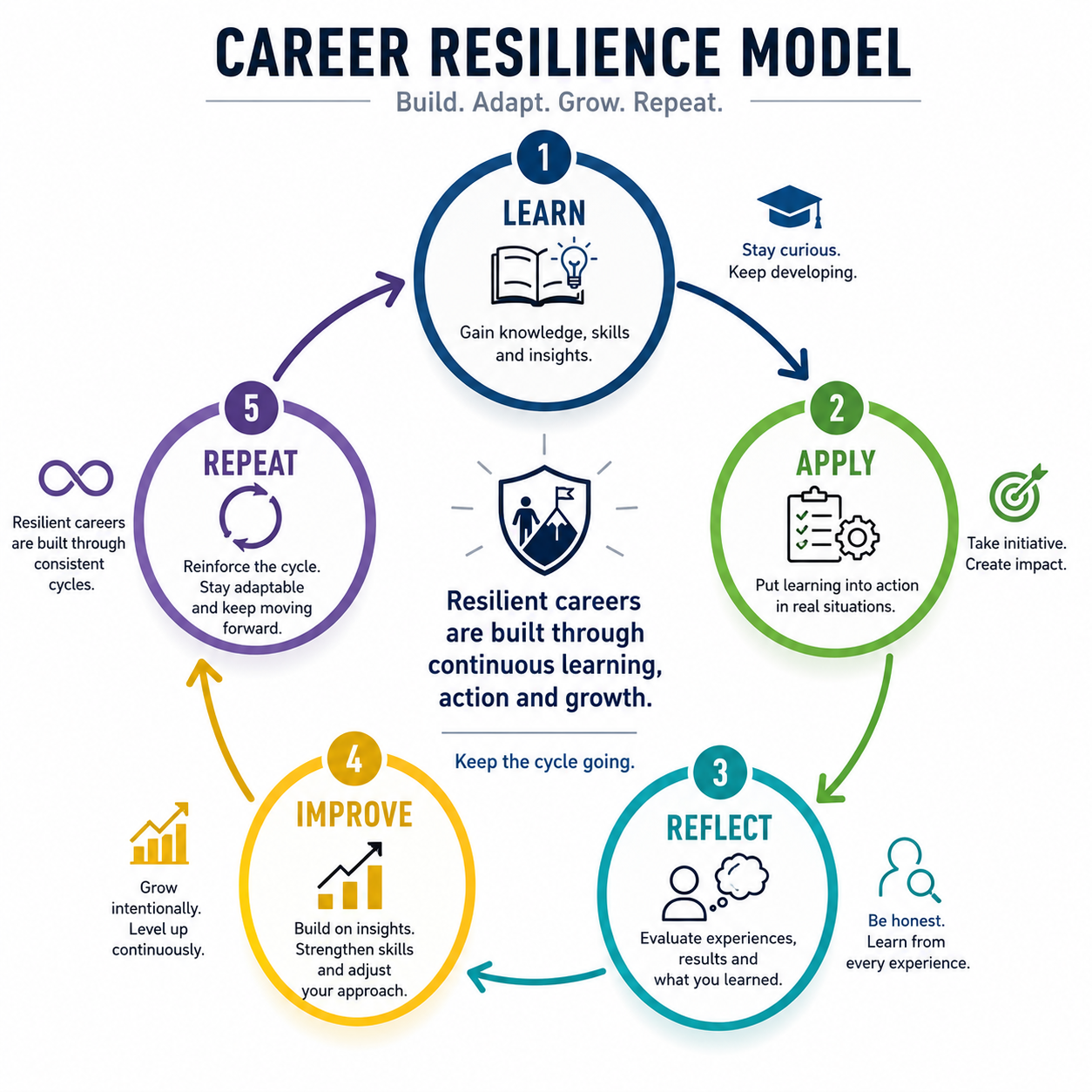
Career growth is iterative—not linear.
AI ERA Insight
Your greatest career security is not your current job.
It is your ability to create value wherever opportunities emerge.
Career Reflection
Finish this sentence.
“If my current position disappeared tomorrow, the skills I could immediately offer another employer would be…”
Write at least five.
Action Checklist
Within the next 30 days:
□ Update LinkedIn.
□ Expand your network by five professionals.
□ Complete one course.
□ Read one book.
□ Start using one AI tool.
Key Takeaways
- Career resilience is built intentionally.
- Networks, learning, and reputation create opportunities.
- Adaptability is becoming a competitive advantage.
Continue Reading
Career resilience requires structure.
That structure is the foundation of the AI ERA Coaching methodology.
Part 6
The AAA Framework
Executive Summary
Knowledge alone does not create career success.
Action does.
The AAA Framework—Align, Adapt, Achieve—is the strategic methodology that underpins AI ERA Coaching. It provides a practical, repeatable approach for navigating career change, professional growth, and leadership development in an AI-driven world.
Whether you are recovering from job loss, pursuing advancement, changing careers, or building a business, the framework helps transform uncertainty into a clear plan of action.
Quick Answer
What is the AAA Framework?
The AAA Framework is a three-phase model designed to help professionals:
- Align with their strengths, values, and opportunities.
- Adapt by developing new capabilities and embracing change.
- Achieve meaningful career outcomes through focused execution.
It is not a one-time exercise. It is a continuous cycle that supports lifelong career development.
Phase One — ALIGN
Every successful career begins with clarity.
Before making changes, understand:
- Your strengths
- Your transferable skills
- Your interests
- Your values
- Your long-term aspirations
- The realities of the current job market
Alignment answers the question:
“Where am I today, and where do I want to go?”
Without alignment, professionals often react to circumstances instead of making intentional decisions.
Phase Two — ADAPT
Once direction is clear, the focus shifts to growth.
Adaptation includes:
- Building AI literacy
- Strengthening human-centered skills
- Updating your résumé and LinkedIn profile
- Expanding your network
- Practicing interviews
- Learning new tools
- Developing leadership capabilities
Adaptation is not about changing who you are.
It is about expanding what you can contribute.
Phase Three — ACHIEVE
Achievement comes through disciplined execution.
This phase emphasizes:
- Goal setting
- Consistent action
- Accountability
- Progress measurement
- Reflection
- Continuous improvement
Small, consistent actions create sustainable career momentum.
The AAA Cycle
Each achievement creates new opportunities for alignment and growth, making the framework a continuous cycle rather than a one-time process.
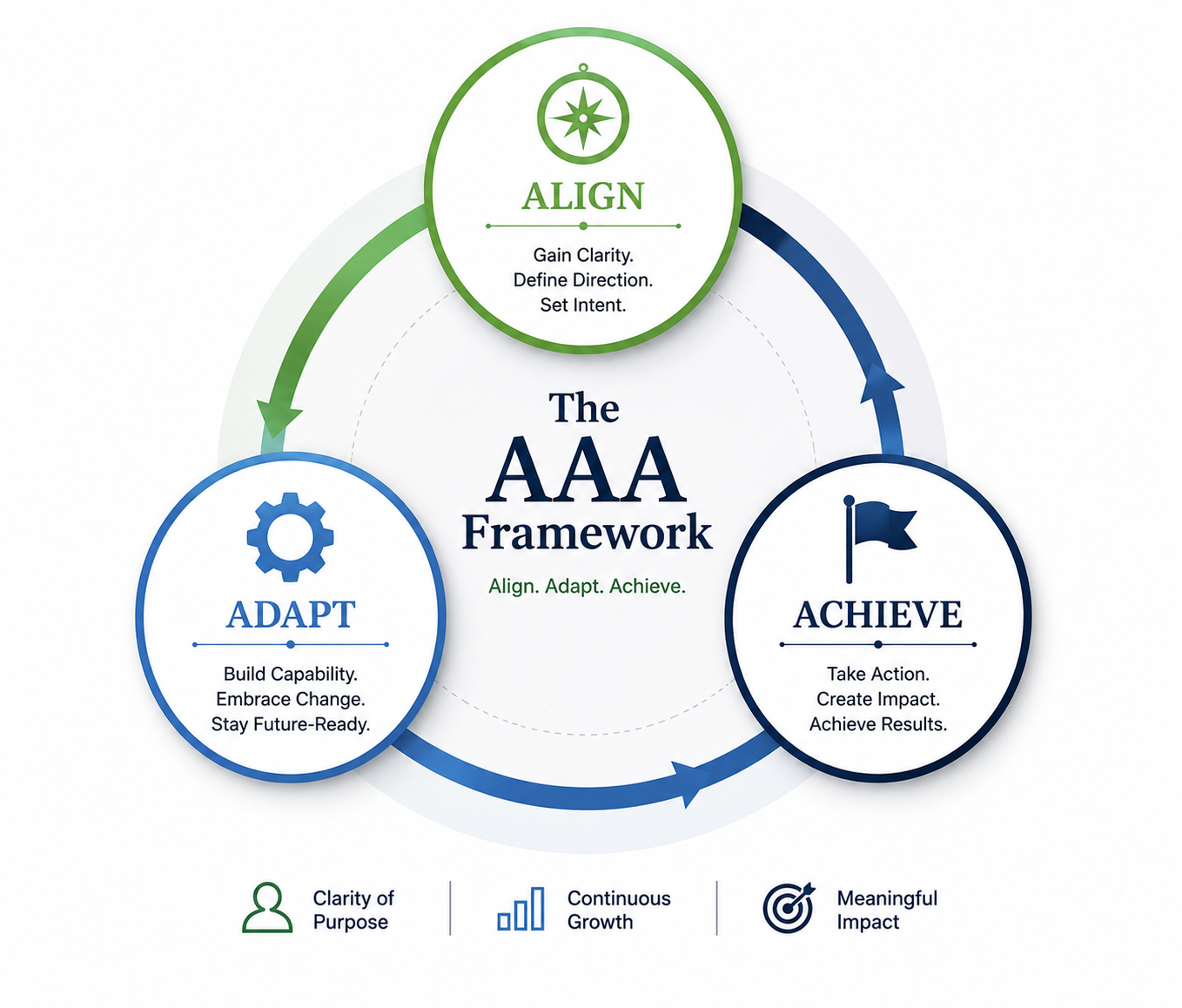
Figure 6.1 — The AAA Framework: Align • Adapt • Achieve
Applying the Framework
Consider a professional who has recently been laid off.
Align
They assess their transferable skills, redefine career goals, and understand how AI is changing their industry.
Adapt
They strengthen their LinkedIn profile, learn AI-assisted productivity tools, refine interview skills, and expand their professional network.
Achieve
They execute a focused job search, build relationships, prepare strategically for interviews, and secure a role aligned with their long-term goals.
The same framework applies to career advancement, executive leadership, career transitions, and entrepreneurial growth.
AI ERA Insight
Career success rarely comes from one major breakthrough.
It is usually the result of consistent alignment, thoughtful adaptation, and disciplined execution.
Career Reflection
Which phase best describes your current situation?
□ I need greater clarity about my direction. (Align)
□ I know where I want to go but need new skills or strategies. (Adapt)
□ I have a plan and need accountability to execute it. (Achieve)
Recognizing where you are today helps determine your next best step.
Action Checklist
This week:
□ Define one long-term career goal.
□ Identify two skills you need to strengthen.
□ Commit to one action you will complete within the next seven days.
Momentum begins with action.
Looking Ahead
Understanding the framework is one thing.
Applying it to your own situation is another.
In Part 7, we’ll help identify the coaching path that best aligns with your current career goals, challenges, and aspirations.
Part 7
Choosing Your AI ERA Coaching Path
Executive Summary
Every career journey is different. Some professionals are rebuilding after an unexpected job loss. Others are preparing for leadership, changing industries, launching a business, or helping employees navigate organizational change.
Choosing the right strategy begins with understanding where you are today.
This chapter will help you identify your current career stage, recognize the challenges you’re facing, and determine which AI ERA Coaching Path best supports your goals.
There is no single “best” path—only the one that best aligns with your present circumstances and future aspirations.
Quick Answer
Which coaching path is right for me?
Your starting point depends on your current situation.
If you have recently lost your job and need to regain momentum, your priorities will be very different from those of a senior executive preparing for a larger leadership role or an experienced professional launching an independent consulting business.
Begin with your current challenge—not your job title.
Start With Your Current Situation
Rather than asking:
“What coaching program do I need?”
Ask yourself:
“What challenge am I trying to solve?”
That answer determines the most appropriate starting point.
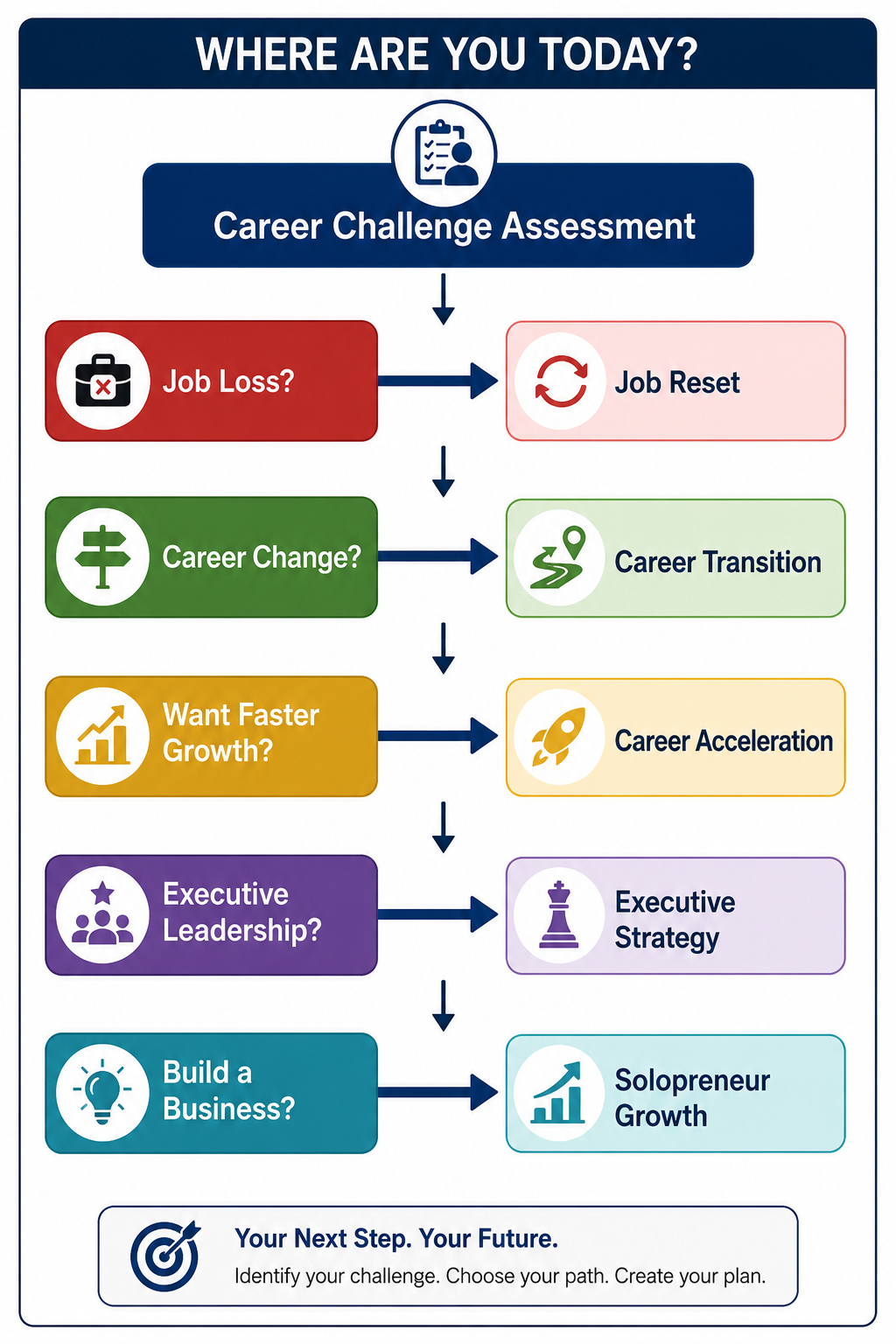
Career Decision Guide
Which statement best describes you today?
A “I recently lost my job, or I expect my role may be eliminated.”
B “I want to change careers but don’t know where to begin.”
C “I’m doing well but want greater responsibility and career growth.”
D “I’m a senior leader preparing for larger organizational responsibilities.”
E “I want to build or grow my own consulting practice or business.”
Visual Framework
Best For
Professionals who have recently experienced job loss, organizational restructuring, redundancy, or significant career disruption.
Typical Challenges
- Uncertainty about next steps
- Financial pressure
- Reduced confidence
- Outdated job search strategies
- Difficulty standing out in a competitive market
Primary Objectives
- Rebuild confidence
- Clarify career direction
- Update professional positioning
- Execute a focused job search
- Return to meaningful employment
What Success Looks Like
A structured plan, renewed confidence, a stronger professional brand, and a successful transition into a new role.
Best For
Professionals seeking to move into a different industry, role, or career direction.
Typical Challenges
- Transferable skills are unclear.
- Previous experience doesn’t appear relevant.
- Difficulty communicating value.
- Fear of starting over.
Primary Objectives
- Identify transferable strengths.
- Build a compelling career narrative.
- Position yourself for new opportunities.
- Develop confidence during career change.
What Success Looks Like
A successful transition into a career aligned with your strengths, interests, and long-term goals.
Best For
Professionals ready to increase their influence, expand responsibilities, and prepare for the next level of leadership.
Typical Challenges
- Feeling overlooked for promotion.
- Limited leadership visibility.
- Plateaued career growth.
- Difficulty demonstrating strategic value.
Primary Objectives
- Strengthen leadership capabilities.
- Increase executive presence.
- Improve communication and influence.
- Build a clear advancement strategy.
What Success Looks Like
Greater visibility, increased responsibility, stronger leadership capability, and accelerated career progression.
Best For
Senior leaders, directors, vice presidents, and executives responsible for leading people, strategy, and organizational transformation.
Typical Challenges
- Leading through uncertainty.
- Managing organizational change.
- Executive communication.
- Strategic decision-making.
- Balancing innovation with execution.
Primary Objectives
- Enhance executive leadership.
- Strengthen strategic thinking.
- Improve organizational influence.
- Lead AI-enabled transformation.
What Success Looks Like
Confident leadership, stronger organizational impact, and sustainable executive growth.
Best For
Independent consultants, coaches, advisors, and professionals building or expanding their own businesses.
Typical Challenges
- Defining a clear market position.
- Attracting ideal clients.
- Building authority.
- Developing scalable systems.
- Integrating AI into business operations.
Primary Objectives
- Clarify your value proposition.
- Build a trusted personal brand.
- Create consistent lead generation.
- Leverage AI to increase productivity.
What Success Looks Like
A sustainable business with clear positioning, efficient systems, and growing client demand.
The Right Path Today Doesn't Define Tomorrow
One important principle underpins the AI ERA Coaching approach:
Your coaching path is not a permanent label.
As your career evolves, your needs will change.
For example:
- A professional may begin with Job Reset, then progress to Career Acceleration after securing a new role.
- An experienced manager may transition into Executive Strategy as leadership responsibilities increase.
- An executive leaving corporate life may choose Solopreneur Growth to build an advisory practice.
Career development is a journey—not a single destination.
AI ERA Insight
The most successful professionals don’t chase every opportunity.
They pursue the opportunities that best align with their goals, strengths, and stage of career.
Clarity creates momentum.
Career Reflection
Complete the following statements:
Today, my greatest career challenge is:
One year from now, I want to be:
The coaching path that best supports that journey is:
Action Checklist
Before moving to the next chapter:
✔ Identify your current coaching path.
✔ Write down your top three career goals.
✔ List the biggest obstacle preventing progress.
✔ Define one action you can complete within the next seven days.
Remember: momentum comes from consistent action, not perfect planning.
Key Takeaways
- Your current challenge—not your job title—determines the best starting point.
- AI ERA Coaching offers five distinct coaching paths aligned to common career situations.
- Career development is a continuous journey, and your needs may evolve over time.
- Choosing the right strategy today creates a stronger foundation for future growth.
Continue Reading
Now that you’ve identified the path that best reflects your current situation, the next question is practical:
How do you successfully compete for opportunities in today’s AI-driven hiring environment?
In Part 8 – Job Search in the AI Era, we’ll explore how recruiting has changed, how AI is influencing hiring decisions, and the strategies professionals can use to strengthen their résumé, LinkedIn profile, networking approach, and interview performance.
Editorial Note
Most career articles simply tell readers to “update your résumé” or “network more.” This chapter should answer a more important question:
How has hiring changed, and how should professionals adapt?
That’s where AI ERA Coaching brings unique value.
Part 8
Job Search in the AI Era
Executive Summary
The job search has changed dramatically over the past decade, and artificial intelligence is accelerating that transformation.
Organizations are using AI to assist with sourcing candidates, screening résumés, identifying skills, scheduling interviews, and supporting hiring decisions. At the same time, candidates have access to AI tools that can help them prepare applications, optimize résumés, research employers, and practice interviews.
While technology has changed the hiring process, one principle remains constant:
Organizations hire people who can solve problems, create value, and work effectively with others.
Technology may help candidates get noticed, but trust, credibility, communication, and preparation ultimately determine who receives the offer.
This chapter explores how hiring has evolved and provides practical strategies to help you compete confidently in today’s AI-enabled job market.
Quick Answer
How should professionals approach job searching in the AI Economy?
A successful job search requires more than submitting applications.
It requires a modern strategy that combines:
- Professional positioning
- AI-assisted preparation
- Targeted networking
- Compelling storytelling
- Interview excellence
- Continuous relationship building
Rather than applying to hundreds of jobs, successful candidates focus on presenting clear value to the right employers.
Why Traditional Job Search Advice Is No Longer Enough
Many professionals still approach job searching the same way they did ten or fifteen years ago.
They:
- update their résumé,
- submit dozens of online applications,
- wait for responses,
- repeat the process.
While this approach may occasionally produce interviews, it often leads to frustration, particularly in a competitive market where employers receive hundreds of applications for a single role.
Today’s hiring environment rewards professionals who take a more strategic approach—one that emphasizes visibility, relationships, relevance, and preparation.
Your job search should be viewed as a professional marketing campaign, not simply an application process.
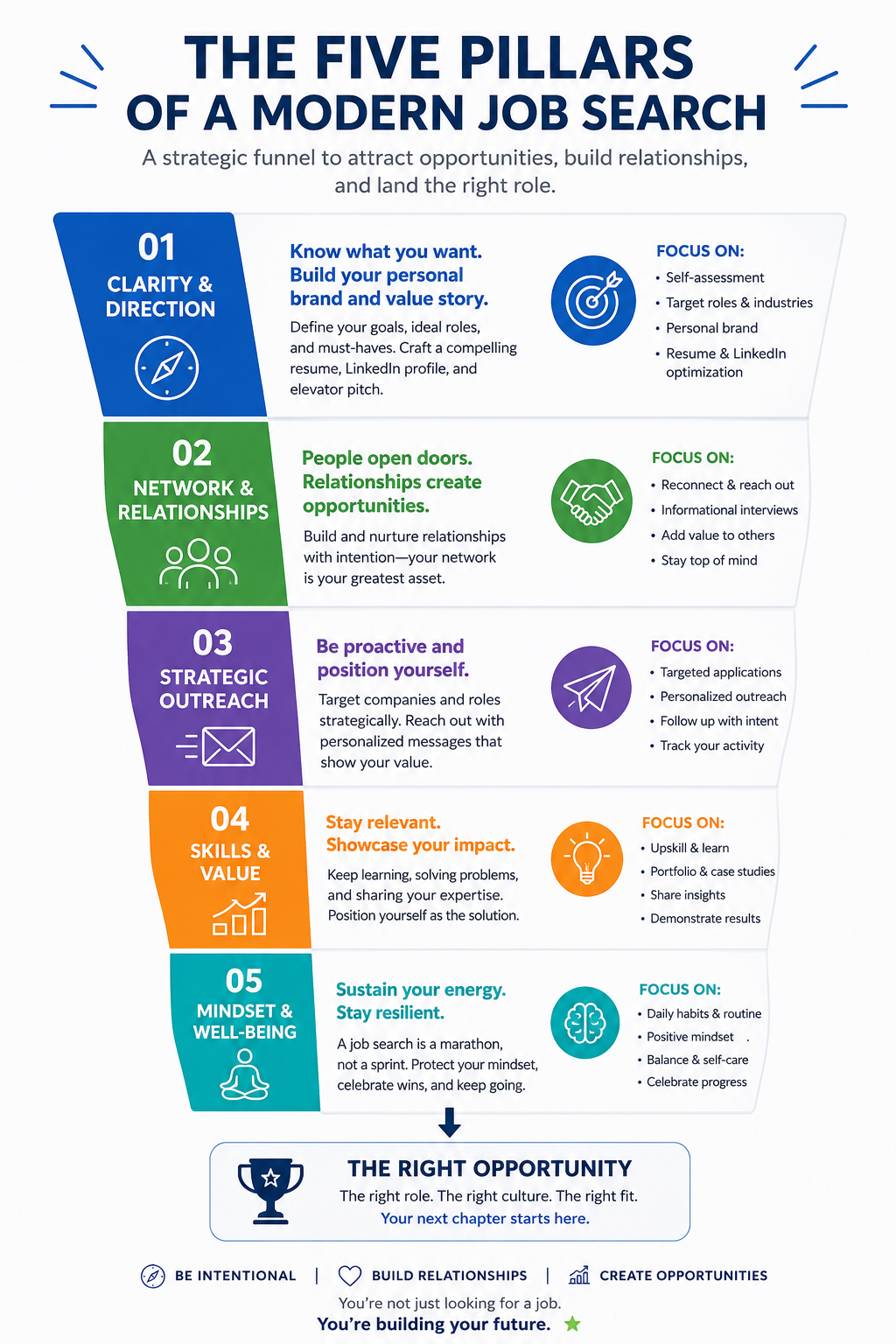
The Five Pillars of a Modern Job Search
1. Professional Positioning
Before employers evaluate your résumé, they evaluate your professional story.
Ask yourself:
- What problems do I solve?
- What makes me different?
- What results have I delivered?
- Why should someone hire me instead of another qualified candidate?
Your résumé, LinkedIn profile, portfolio, and interview responses should all reinforce the same message.
Consistency builds credibility.
2. Your Résumé Is a Marketing Document
One of the biggest misconceptions is that a résumé should list everything you’ve done.
Instead, it should demonstrate the value you’ve created.
Employers are interested in outcomes, not just responsibilities.
Compare these examples:
Task-focused
“Managed project schedules and coordinated meetings.”
Value-focused
“Led cross-functional projects that improved delivery timelines by 18% while coordinating stakeholders across four departments.”
The second statement tells a stronger story because it demonstrates measurable impact.
Career Coach Tip
Think of every résumé bullet as evidence—not a job description.
Ask:
“What changed because I did this work?”
3. LinkedIn Is Your Professional Brand
Before employers evaluate your résumé, they evaluate your professional story.
Ask yourself:
- What problems do I solve?
- What makes me different?
- What results have I delivered?
- Why should someone hire me instead of another qualified candidate?
Your résumé, LinkedIn profile, portfolio, and interview responses should all reinforce the same message.
Consistency builds credibility.
4. Networking Creates Opportunity
Many professionals think networking is asking people for jobs.
Effective networking is something different.
It is about building genuine professional relationships before you need assistance.
Networking can include:
- reconnecting with former colleagues,
- attending professional events,
- participating in industry communities,
- joining online discussions,
- offering help to others.
Strong networks often uncover opportunities that never appear on job boards.
AI ERA Insight
Opportunities usually travel through relationships before they appear in recruitment systems.
5. Interview Preparation Creates Confidence
Many candidates spend weeks perfecting their résumé and only a few hours preparing for interviews.
This is backwards.
Once you earn an interview, your ability to communicate clearly becomes your greatest competitive advantage.
Preparation should include:
- researching the organization,
- understanding the role,
- preparing behavioral examples,
- practicing executive communication,
- asking thoughtful questions.
Confidence is built through preparation—not improvisation.
How AI Can Help Your Job Search
Artificial intelligence can become a valuable career partner when used thoughtfully.
Examples include:
- brainstorming résumé language,
- refining LinkedIn headlines,
- researching companies,
- organizing job search activities,
- generating interview questions,
- practicing interview responses,
- summarizing industry trends.
However, AI should enhance your work—not replace your authentic voice.
Recruiters and hiring managers quickly recognize generic, overly polished responses that lack personal insight.
Your experiences, accomplishments, and perspective remain your greatest differentiators.
Common Job Search Mistakes
Avoid these common pitfalls:
- Applying for every available role without a clear strategy.
- Sending the same résumé to every employer.
- Ignoring networking opportunities.
- Underestimating interview preparation.
- Relying entirely on AI-generated application materials.
- Failing to research the organization.
- Waiting passively for recruiters to make contact.
An intentional, focused job search consistently outperforms a reactive one.
AI ERA Insight
The strongest candidates don’t simply tell employers what they have done.
They help employers understand the problems they can solve.
That shift—from listing experience to demonstrating value—is often what separates successful candidates from the competition.
Career Reflection
Take a moment to assess your current job search.
Rate yourself from 1 (Needs Attention) to 5 (Strong).
| Area | Rating |
| My résumé demonstrates measurable impact. | □ |
| My LinkedIn profile reflects my current value. | □ |
| I actively maintain my professional network. | □ |
| I prepare thoroughly for interviews. | □ |
| I use AI responsibly to improve my job search. | □ |
| I have a focused target list of employers. | □ |
Which two areas offer the greatest opportunity for improvement?
Action Checklist
This week:
✔ Review your résumé and replace at least three task-focused bullets with achievement-focused statements.
✔ Refresh your LinkedIn headline and About section.
✔ Reach out to three professional contacts.
✔ Research one organization before submitting an application.
✔ Practice answering three behavioral interview questions aloud.
Small improvements made consistently often produce significant results over time.
Key Takeaways
- A successful job search is built on strategy, not volume.
- Your résumé and LinkedIn profile should communicate value, not simply responsibilities.
- Networking remains one of the most effective ways to discover opportunities.
- AI can strengthen your preparation, but authenticity remains essential.
- Interview preparation is where strong candidates distinguish themselves.
Looking Ahead
Landing the next opportunity is only part of long-term career success.
As professionals advance, they face a different challenge:
How do you lead effectively in a workplace where people and AI increasingly work together?
In Part 9 – Leadership in the AI Economy, we’ll explore how leadership is evolving, why human-centered leadership is becoming more valuable, and the capabilities organizations will expect from tomorrow’s leaders.
Part 9
Leadership in the AI Economy
Executive Summary
Leadership has always been about helping people achieve results through vision, communication, trust, and sound decision-making.
Artificial intelligence does not change these responsibilities.
It amplifies them.
As organizations integrate AI into everyday operations, leaders face a new challenge: balancing technological innovation with human performance. They must make informed decisions, guide teams through uncertainty, encourage continuous learning, and build cultures where people and technology work together effectively.
The leaders who succeed in the AI economy will not be those who know the most about artificial intelligence.
They will be those who understand how to lead people through change.
Quick Answer
What makes an effective leader in the AI Economy?
Successful AI-era leaders combine technological curiosity with deeply human capabilities.
They:
- embrace continuous learning,
- communicate with clarity,
- make ethical decisions,
- build trust,
- encourage innovation,
- coach rather than control,
- help people adapt with confidence.
Technology may improve productivity.
Leadership determines whether people embrace change or resist it.
Leadership Is Being Redefined
For decades, many organizations rewarded leaders for having answers.
Today’s workplace demands something different.
Leaders must now ask better questions.
Instead of saying,
“This is how we’ve always done it.”
Effective leaders ask,
- What problem are we trying to solve?
- Could AI improve this process?
- What risks should we consider?
- How do we ensure people remain engaged?
- How do we measure success?
The shift is subtle but significant.
Leadership is becoming less about directing work and more about enabling performance.
The Five Leadership Capabilities of the AI Economy
1. Learning Leadership
The pace of technological change means leaders cannot wait until they know everything before taking action.
Instead, effective leaders create environments where learning is expected, experimentation is encouraged, and mistakes are seen as opportunities for improvement.
Learning organizations consistently outperform organizations that resist change.
Leadership Reflection
Ask yourself:
When was the last time I intentionally learned something completely new?
Your team notices whether you continue learning.
2. Human-Centered Leadership
Technology changes workflows.
People determine success.
Employees continue to seek leaders who:
- listen,
- communicate honestly,
- recognize contributions,
- provide direction,
- build confidence,
- create psychological safety.
These qualities cannot be automated.
In many ways, they become even more valuable as organizations become more digital.
3. Decision-Making in an AI World
Artificial intelligence can provide remarkable insights.
It cannot replace leadership judgment.
Responsible leaders understand:
- When to trust AI,
- When to verify information,
- When ethics outweigh efficiency,
- When experience matters more than prediction.
AI should inform decisions.
Leaders remain accountable for making them.
4. Leading Through Change
Every significant technological shift creates uncertainty.
Employees often wonder:
- Will my job change?
- Will my skills still matter?
- What should I learn next?
- What does this mean for my future?
Outstanding leaders address these concerns openly.
They explain:
- Why is change occurring,
- what it means,
- how people will be supported,
- What success looks like.
Communication reduces uncertainty.
Silence increases it.
5. Developing Future Leaders
One of the most important responsibilities of leadership is preparing others for success.
In the AI economy, this includes helping employees:
- build new skills,
- increase confidence,
- experiment safely,
- embrace continuous improvement,
- think strategically.
Leadership is no longer measured solely by personal achievement.
It is increasingly measured by how effectively leaders develop their team members.
Human Skills Are Becoming Leadership Skills
As artificial intelligence becomes more capable, organizations increasingly differentiate leaders by capabilities that technology cannot replicate.
These include:
| Leadership Capability | Why It Matters |
| Emotional Intelligence | Builds trust and engagement |
| Strategic Thinking | Connects decisions to long-term goals |
| Communication | Creates clarity during change |
| Coaching | Develops people rather than directing them |
| Adaptability | Responds effectively to uncertainty |
| Ethical Judgment | Ensures responsible use of AI |
| Collaboration | Brings diverse expertise together |
| Curiosity | Encourages innovation and learning |
Notice something interesting.
Almost none of these involve technology itself.
Leadership remains fundamentally human.
Leading Teams That Work Alongside AI
As AI becomes integrated into daily work, leaders will increasingly manage teams where technology performs part of the workflow.
That changes leadership conversations.
Instead of asking:
“How many tasks did we complete?”
Leaders begin asking:
- What decisions required human judgment?
- Where did AI improve efficiency?
- Where did human expertise improve quality?
- What did we learn?
- What should we improve next?
Performance becomes a partnership between people and technology.
Ethical Leadership
One of the defining characteristics of the AI economy will be ethical leadership.
Organizations must consider questions such as:
- How was this AI recommendation generated?
- Could bias affect this decision?
- Is customer privacy protected?
- Should humans review this outcome?
- Does this align with our organizational values?
Technology creates capability.
Leadership provides responsibility.
Organizations that ignore ethics risk damaging trust, reputation, and long-term success.
AI ERA Insight
The leaders who create the greatest value will not be those who adopt AI the fastest.
They will be those who help people use AI wisely, responsibly, and confidently.
Leadership has always been about people.
That will not change.
Leadership Reflection
Think about your current leadership style.
Which statement best describes you?
□ I focus primarily on operational efficiency.
□ I spend most of my time solving problems.
□ I actively coach and develop others.
□ I encourage experimentation and innovation.
□ I create clarity during periods of uncertainty.
Now ask yourself:
Which leadership capability should I intentionally strengthen over the next six months?
Leadership Action Checklist
Over the next 30 days:
✔ Learn one new AI capability relevant to your role.
✔ Schedule a coaching conversation with a team member.
✔ Review one process that AI could improve.
✔ Encourage your team to experiment responsibly.
✔ Ask for feedback on your communication during change.
Leadership improves through intentional practice.
Key Takeaways
- Leadership in the AI economy is increasingly centered on people rather than technology.
- Human capabilities such as communication, coaching, adaptability, and ethical judgment are becoming stronger competitive advantages.
- AI enhances decision-making, but leaders remain accountable for outcomes.
- Organizations need leaders who create trust, encourage learning, and guide people through change.
- Great leaders help both technology and people succeed together.
Career Coach Tip
One of the questions I encourage leaders to ask during every major technology initiative is:
“How will this help our people do their best work?”
Notice that the question isn’t:
“How much money will we save?”
Both matter.
But organizations that begin with people often achieve stronger long-term business outcomes because engaged employees adapt more readily, innovate more effectively, and build greater trust with customers.
Technology should enable human potential—not replace it.
Looking Ahead
Understanding the future of work is valuable.
Building the skills to succeed is essential.
But lasting career success ultimately comes from taking deliberate action.
In the final chapter of this guide, we’ll bring everything together into a practical roadmap you can begin implementing immediately.
You’ll create your own AI Career Action Plan—a step-by-step approach for aligning your goals, adapting your skills, and achieving meaningful progress in the AI economy.
Part 10
Your AI Career Action Plan
Executive Summary
Knowledge creates awareness.
Action creates results.
Throughout this guide, you’ve explored how artificial intelligence is transforming work, which skills are becoming more valuable, how industries are evolving, and how the AAA Framework can help you navigate career growth with confidence.
The final step is to turn those insights into a practical plan.
The AI economy will continue to evolve. You don’t need to predict every change, but you do need a process for learning, adapting, and moving forward with purpose.
This chapter provides that process.
Quick Answer
What should I do next?
You don’t need to do everything at once.
Begin with three simple steps:
- Understand where you are today.
- Decide where you want to be.
- Take one meaningful action every week.
Career growth is built through consistent progress—not dramatic leaps.
The AI ERA Career Roadmap
This roadmap reflects the AAA Framework in action.
Step 1 — Assess Your Current Position
Every journey begins with understanding your starting point.
Ask yourself:
Career
- Am I fulfilled in my current role?
- Is my industry changing?
- Am I prepared for future opportunities?
Skills
- Which of my skills are growing in value?
- Which needs updating?
- How comfortable am I using AI tools?
Professional Brand
- Does my résumé reflect measurable achievements?
- Is my LinkedIn profile current?
- Am I visible within my professional community?
Network
- Do I regularly maintain professional relationships?
- Who can I learn from?
- Who could benefit from my expertise?
Leadership
- Am I preparing for my next level of responsibility?
Write your answers honestly.
Clarity creates momentum.
Step 2 — Define Your Destination
Many professionals know what they want to leave.
Far fewer know what they want to build.
Instead of asking:
“What job do I want?”
Ask:
“What kind of career do I want to create over the next five years?”
Consider:
- The type of work that energizes you.
- The problems you enjoy solving.
- The industries you want to serve.
- The impact you want to make.
- The lifestyle you want to support.
Purpose provides direction when circumstances change.
Step 3 — Build Your 90-Day Growth Plan
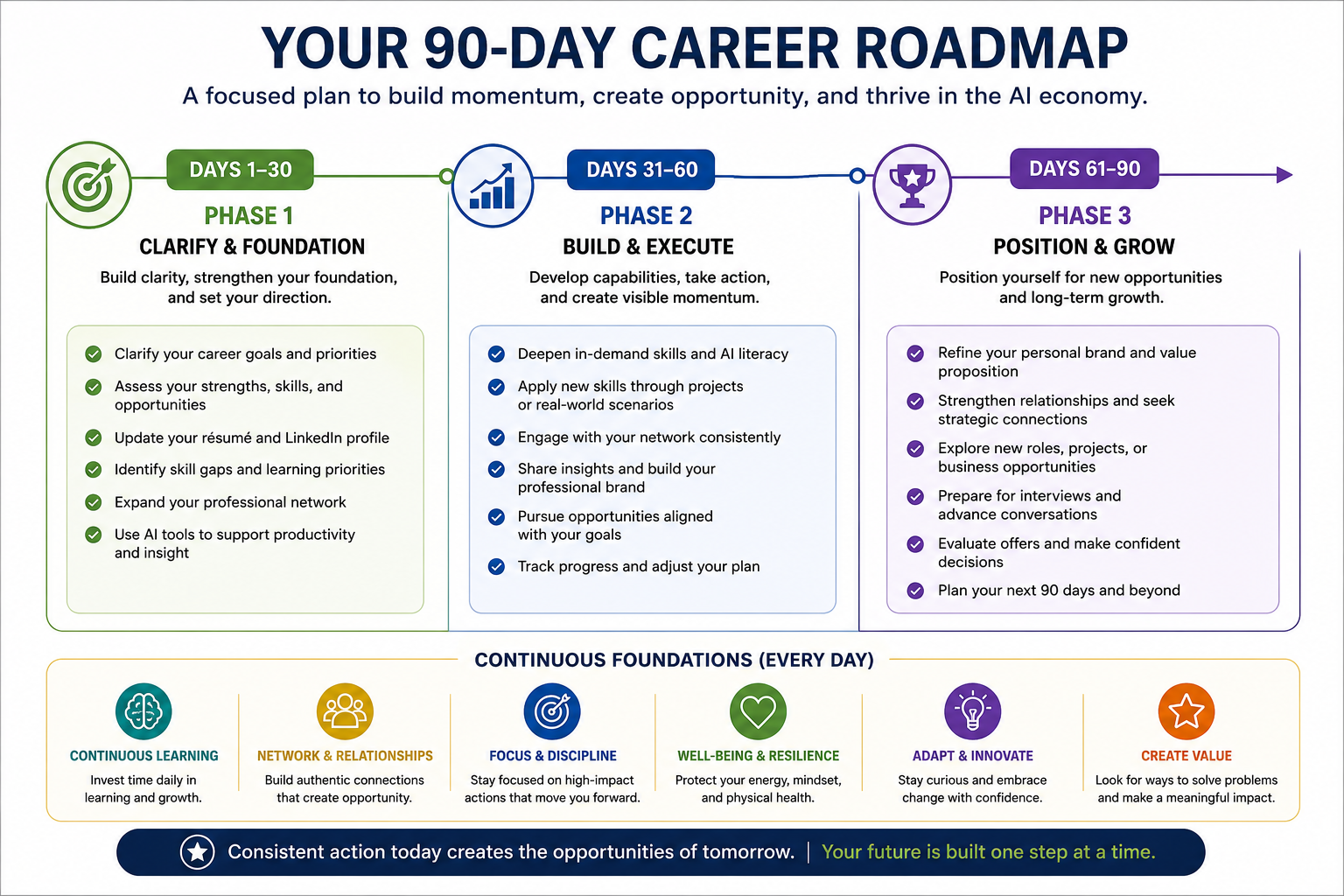
Days 1–30 — Align
Objective: Build clarity and create a strong foundation.
Focus on:
✔ Assessing your strengths.
✔ Defining career goals.
✔ Identifying skill gaps.
✔ Researching industry trends.
✔ Updating your professional brand.
Success Milestone
You have a clear understanding of your current position and future direction.
Days 31–60 — Adapt
Objective: Strengthen your capabilities.
Focus on:
✔ Learning one AI tool relevant to your profession.
✔ Completing an online course or certification.
✔ Expanding your professional network.
✔ Practicing interview or leadership skills.
✔ Developing a personal learning routine.
Success Milestone
You are actively building skills that increase your professional value.
Days 61–90 — Achieve
Objective: Execute with confidence.
Focus on:
✔ Applying for targeted opportunities.
✔ Scheduling networking conversations.
✔ Publishing professional insights on LinkedIn.
✔ Seeking stretch assignments.
✔ Tracking measurable progress.
Success Milestone
You are taking consistent action toward meaningful career goals.
Your Personal Commitment
Take a moment to commit yourself.
I will remain curious.
I will continue learning.
I will embrace change rather than fear it.
I will strengthen the skills that technology cannot replace.
I will intentionally build a career aligned with my values and aspirations.
This serves as a reminder that career growth is an ongoing choice.
AI ERA Insight
The future does not belong to the professionals who know the most today.
It belongs to those who remain willing to learn, adapt, and lead tomorrow.
Technology will continue to evolve.
Your willingness to grow will determine how you benefit from that evolution.
Career Reflection
Before you finish this guide, answer these questions:
- What is the most important insight you’ve gained?
- Which skill will have the greatest impact on your career over the next year?
- What action will you take within the next seven days?
- Who can support and encourage your growth?
- What would success look like one year from today?
These answers become the foundation of your personal career strategy.
Your Next Best Step
You’ve completed The Complete Guide to Navigating Careers in the AI Economy.
Now it’s time to turn what you’ve learned into a clear, confident plan for what’s next.
Whether you’re rebuilding after a job loss, exploring a career transition, preparing for leadership, or building an independent business, AI ERA Coaching provides structured pathways designed to help you move forward with purpose in the AI economy.
Ready for Your Next Move?
Find the path that best fits your goals—and take the next step with confidence.
Explore the AI ERA Coaching Paths.
Need Help Choosing?
Not everyone begins with complete clarity—and that’s perfectly normal.
If you’re unsure which coaching path best fits your experience, goals, or current career situation, the Career Assessment will help identify your most appropriate starting point.
Receive a personalized coaching path recommendation.
Final Thoughts
The workplace will continue to change.
New technologies will emerge.
Industries will evolve.
Roles will be redesigned.
Some opportunities will disappear, while entirely new ones will be created.
These changes are inevitable.
What remains within your control is how you respond.
The professionals who succeed will not be those who wait for certainty. They will be those who remain curious, invest in continuous learning, build meaningful relationships, and take thoughtful action.
Your career is not defined by a single job, employer, or technology.
It is defined by your ability to create value throughout a lifetime of change.
That is the opportunity presented by the AI economy.
And that is the purpose of AI ERA Coaching.
Guide Summary
Throughout this guide, you’ve learned how to:
- Understand the forces shaping the AI economy.
- Recognize how AI is transforming work across industries.
- Build the technical and human skills that create long-term value.
- Develop career resilience through continuous learning.
- Apply the AAA Framework (Align • Adapt • Achieve) to your professional growth.
- Identify the coaching path that best aligns with your current career stage.
- Navigate today’s AI-enabled hiring environment with confidence.
- Lead people effectively through technological change.
- Create a practical action plan for the next 90 days and beyond.
The future of work is still being written.
You now have the knowledge, framework, and roadmap to help shape your place within it.
Thank you for investing your time in this guide.